
- Why Custom Applications Matter for
HealthTech Innovation
In this article, we explore why custom HealthTech applications are essential and how CogniXsoft helps healthcare organizations solve complex digital challenges.
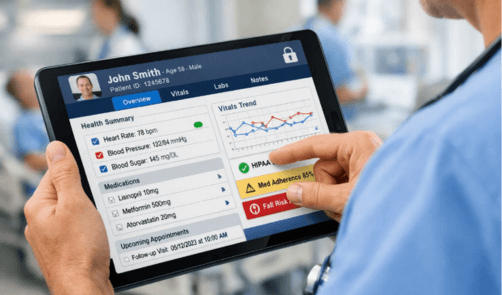
Healthcare technology is not just about digitization – it’s about precision, trust, and real-world usability. While many industries can adapt to generic software, healthcare cannot afford compromise. Clinical workflows, patient safety, regulatory mandates, and data sensitivity demand solutions that fit perfectly.
This is why custom applications have become a foundational requirement in HealthTech. They are built to reflect how care is actually delivered, not how software vendors assume it should work.
Healthcare operates under conditions that few other industries face simultaneously. Systems must manage vast volumes of sensitive data while supporting clinicians in high-pressure environments where accuracy is critical. Add regulatory frameworks like HIPAA and evolving care models such as telemedicine and remote monitoring, and it becomes clear why rigid software struggles to keep up.
The digital health market is projected to grow beyond $600 billion over the next decade, yet many healthcare organizations still rely on tools that were never designed for modern care delivery. This disconnect often results in inefficiencies, clinician burnout, and fragmented patient experiences.
Off-the-shelf healthcare software is designed to solve broad problems, but healthcare problems are rarely broad. Every hospital, clinic, and HealthTech startup operates with distinct workflows, patient demographics, and compliance obligations. Generic tools force teams to adapt their processes to the software instead of the other way around.
Integration is another major limitation. Healthcare ecosystems depend on seamless data flow between EHRs, labs, pharmacies, insurance platforms, and connected devices. When systems fail to communicate effectively, clinicians lose time and patients face delays. Compliance, too, becomes harder to manage when security controls are not deeply embedded into application architecture.
Custom HealthTech applications are designed around real clinical and operational needs. Instead of imposing fixed workflows, they support how doctors, nurses, and administrators actually work. This leads to faster adoption, fewer errors, and improved productivity across care teams.
Security and compliance are not added later-they are engineered into the foundation. Custom applications allow granular access control, encrypted data handling, detailed audit trails, and patient consent management that align with regulatory requirements. As organizations grow, these platforms scale naturally, supporting new services, locations, and patient volumes without disruptive rework.
The benefits of custom HealthTech applications go beyond IT efficiency. Patients experience smoother access to care through personalized portals, appointment management, and real-time health insights. Clinicians benefit from systems that reduce administrative workload and surface relevant data at the right moment.
Operationally, healthcare organizations gain better visibility into outcomes, resource utilization, and compliance performance. Over time, this leads to cost optimization, better decision-making, and improved quality of care.
Successful HealthTech applications begin with a deep understanding of the problem being solved. This includes clinical workflows, regulatory expectations, and patient journeys. Architecture must prioritize compliance, interoperability, and security from day one.
Rigorous testing, including real-world clinical scenarios, ensures reliability in high-stakes environments. Continuous optimization keeps the application aligned with evolving regulations, technologies, and user expectations.
Custom applications are transforming healthcare delivery across use cases. Remote patient monitoring platforms enable continuous care outside hospitals, reducing readmissions and improving chronic disease management. Telemedicine solutions expand access to care while maintaining clinical quality. Decision support tools help clinicians make faster, data-driven treatment choices.
Each of these solutions succeeds because it is tailored to specific healthcare needs—not forced into a generic mold.
At CogniXsoft, custom application development is approached as a strategic healthcare investment. CogniXsoft works closely with healthcare organizations to design, build, and scale applications that meet strict security and compliance standards while delivering measurable clinical and operational value.
From HIPAA-compliant architectures to advanced integrations and analytics, CogniXsoft helps HealthTech companies turn complex challenges into scalable digital solutions.
Healthcare challenges are complex by nature, and generic software cannot keep pace with their demands. Custom applications provide the flexibility, security, and precision required to deliver better patient outcomes and sustainable innovation.
As healthcare continues its digital evolution, organizations that invest in purpose-built HealthTech applications will lead the next generation of care delivery.
Subscribe to the CogniXsoft newsletters – Join our community to receive the latest insights, industry trends, and exclusive updates on our services.